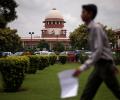
The Supreme Court has deleted its critical observation against Allahabad High Court judge Prashant Kumar, clarifying that it did not intend to embarrass or cast aspersions on him. The decision follows a request from Chief Justice B R Gavai to reconsider the matter.
The Supreme Court is hearing arguments regarding a presidential reference on whether fixed timelines can be imposed on governors and the president for acting on bills passed by state legislatures. The court is considering objections to the maintainability of the reference under Article 143 of the Constitution.

The Congress party has accused Union Minister Nitin Gadkari of conflict of interest, alleging his sons' companies have benefited from the government's ethanol blending policy. The BJP has rejected the allegations.

BJP-ruled states argued in the Supreme Court that governors and the President have autonomy in assenting to bills passed by state assemblies, asserting that courts cannot mandate assent.

The Supreme Court is scheduled to hear a plea on August 8 seeking directions to the Centre for the restoration of statehood to Jammu and Kashmir. The plea highlights concerns about the delay and its impact on democratic rights and development.

In a significant development, the Supreme Court on Thursday recalled its controversial May 2 verdict that had ordered liquidation of Bhushan Power & Steel Limited (BPSL) while setting aside a resolution plan of JSW Steel Limited for the ailing firm. A bench comprising Chief Justice B R Gavai and Justice Satish Chandra Sharma observed that the May 2 judgment, authored by Justice Bela M Trivedi, since retired, did not "correctly consider the legal position as has been laid down in the catena of judgments".
A Constitution bench comprising Chief Justice B R Gavai and Justices Surya Kant, Vikram Nath, P S Narasimha and A S Chandurkar, would fix the timelines on July 29 and commence hearing on the presidential reference in mid-August.
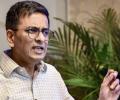
In an unprecedented move, the Supreme Court administration has written to the Centre for vacating the official residence of the Chief Justice of India at Krishna Menon Marg in New Delhi, noting that the current occupant ex-CJI D Y Chandrachud has stayed beyond the permissible period.
The Supreme Court has stayed the Calcutta High Court's decision that stalled the implementation of a revised list of Other Backward Classes (OBCs) in West Bengal, providing relief to the state government.
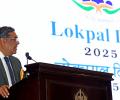
The Supreme Court of India will examine the jurisdiction of the Lokpal, India's anti-corruption ombudsman, in entertaining complaints against sitting high court judges. The court is considering a suo motu proceeding initiated over the Lokpal's January 27 order on the issue. The case involves two complaints filed against a sitting additional judge of a high court, alleging that he influenced a judge of the subordinate judiciary and a judge of the same high court set to deal with a suit filed against the complainant by a private company.

The Supreme Court collegium has recommended the appointment of Karnataka High Court Chief Justice N V Anjaria, Gauhati High Court Chief Justice Vijay Bishnoi, and Bombay High Court judge Justice A S Chandurkar as judges of the Supreme Court. The five-member collegium, headed by Chief Justice B R Gavai, decided to recommend the names to fill three existing vacancies in the top court. The appointments follow the superannuation of former Chief Justice Sanjiv Khanna, and Justices Abhay S Oka and Hrishikesh Roy. The Supreme Court, which has a sanctioned strength of 34 judges, is currently working with 31 judges.
The Supreme Court has initiated a suo motu case regarding investigation agencies summoning lawyers and will examine if they can be put to notice. The action follows the Enforcement Directorate summoning senior lawyers, which was condemned by bar associations.

After the conclusion of the ceremonial bench proceedings, the CJI met journalists in the apex court premises and said,

A two-judge bench of the top court had on August 11 directed authorities in Delhi-National Capital Region (NCR) to start picking up stray dogs from all localities "at the earliest" and relocate the animals to dog shelters.

Chief Minister Omar Abdullah strongly criticized linking Jammu and Kashmir's political future to acts of terror, asserting that Pakistan cannot influence decisions on the region's statehood through terrorism. He announced a signature campaign to press for the restoration of statehood.

The Supreme Court expressed serious concern over the Enforcement Directorate summoning advocates for offering legal advice or representing clients during investigations, calling for guidelines on the matter.
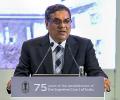
Justice Sanjiv Khanna 'belongs to that school of legal luminaries who give the highest primacy to facts.'
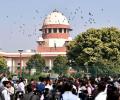
The Supreme Court on Monday agreed to hear a plea of Ashoka University's political science department head Ali Khan Mahmudabad challenging his arrest for social media posts related to Operation Sindoor.
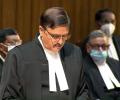
Justice Abhay S Oka, known for his unwavering commitment to liberty and constitutional values, bid farewell to the Supreme Court of India. In his final address, he stressed his dedication to upholding constitutional liberties, emphasizing that it was his "honest endeavor" to fulfill the dream of the Constitution's framers. He also expressed gratitude to the bar and his colleagues for their support and shared heartfelt memories from his time on the bench. Justice Oka's departure marks the end of a distinguished judicial career spanning over two decades, during which he served as a judge of the Bombay High Court, Chief Justice of the Karnataka High Court, and ultimately, as a Supreme Court justice.
'Non-BJP state governments and their leaders, navigating today's political landscape, know well they have no clue what awaits around the corner.' 'The chances of charges pressed and oneself getting parked in custody play out on an uneven playing field,' points out Shyam G Menon.

The SC has sought a response from the Centre on a plea seeking the restoration of statehood to Jammu and Kashmir.
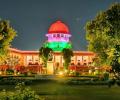
The Centre has told the Supreme Court that imposing fixed timelines on governors and the president to act on bills passed by a state Assembly would amount to one organ of the government assuming powers not vested in it by the Constitution and lead to a "constitutional disorder".

The Supreme Court has questioned the practice of Governors withholding assent to bills indefinitely, stating that it renders the constitutional provision of 'as soon as possible' meaningless.
A bench comprising Chief Justice B R Gavai and Justices Augustine George Masih and AS Chandurkar also directed that the offending video be immediately taken down and restrained the YouTube channel from republishing it or similar content.

Issuing notice to the ED on the plea filed by the Tamil Nadu government and Tamil Nadu State Marketing Corporation (TASMAC), a bench comprising Chief Justice B R Gavai and Justice Augustine George Masih told Additional Solicitor General S V Raju, appearing for the anti-money laundering probe agency, that "Your ED is crossing all the limits."

The Supreme Court of India dismissed a plea seeking the inclusion of Vinayak Damodar Savarkar's name in the Emblems and Names (Prevention of Improper Use) Act, 1950. The petitioner, appearing in person, argued for the inclusion based on his 30 years of research and claimed a need to establish facts about Savarkar in a legally verifiable manner. However, the court found no violation of fundamental rights and suggested the petitioner make a representation to the Union of India for curriculum inclusion. This dismissal follows the court's earlier reprimand of Congress leader Rahul Gandhi for his remarks on Savarkar at a rally in Maharashtra, although criminal proceedings against Gandhi were stayed.
The Tamil Nadu government has urged the Supreme Court to dismiss the Presidential reference concerning the Governor's powers to assent to bills, arguing it is an 'appeal in disguise' to overturn settled law.

'Day by day we expose how soulless we have become as a society. Every day is a disappointment.'
A five-judge Constitution bench of the Supreme Court is scheduled to consider the Presidential reference on whether timelines could be imposed by judicial orders for the exercise of discretion by the President while dealing with bills passed by state assemblies.
The Supreme Court of India granted bail to an accused in a cheating case being investigated by the Central Bureau of Investigation (CBI), criticizing the Allahabad High Court for adjourning the bail hearing 27 times. The Supreme Court deemed the repeated adjournments in a matter related to personal liberty unacceptable and issued a notice to the CBI.
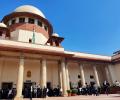
The Supreme Court addressed the issue of probe agencies summoning lawyers for providing legal advice to clients under investigation, emphasising that lawyers should not be summoned merely for offering legal advice but can be if they are assisting in the crime. The court is considering guidelines to prevent investigative overreach and protect lawyer-client privilege.
The Union Cabinet, at a meeting chaired by Prime Minister Narendra Modi, held a detailed discussion on the Supreme Court judgement on the sub-categorisation of reservation for SCs and STs as granted in the Constitution.
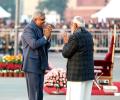
The BJP had no option but to get Jagdeep Dhankhar out of its way for the sake of the Modi government's stability, reveals Sheela Bhatt, the legendary political journalist.
The Supreme Court of India has sought responses from the Centre and others on a petition challenging the constitutional validity of certain provisions of the Waqf Act, 1995. The petition argues that the Act gives undue favor to waqf properties and deprives non-Muslims of their property rights. The court has tagged the petition with pending petitions that raise similar issues.

On Thursday, MMRDA strongly defended its decision to disqualify L&T from the two infrastructure projects in Mumbai, citing "substantial grounds" for the rejection of its technical bids.
A bench of Justices Surya Kant and N Kotiswar Singh deferred the hearing on Shah's plea after his counsel and senior advocate Maninder Singh made a request.

The matter would be heard by Chief Justice B R Gavai and Justice Augustine George Masih.

"It is a policy matter. You ask Parliament to enact the law," a bench of Justices B R Gavai and Augustine George Masih told the counsel appearing for the petitioner.
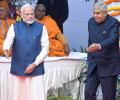
The RSS which catapulted Jagdeep Dhankar to national prominence after 21 years of hibernation could not come to his rescue when BJP higher ups decided to seek his resignation, points out Prakash Bhandari.

As soon as one of the pleas came up for hearing on Friday, Solicitor General Tushar Mehta, appearing for the Centre, objected and said there can't be an "endless" filing of pleas challenging the Act.
 © 2026 Rediff.com - Advertise with us - Disclaimer - Privacy Policy - Sitemap - Feedback - About us - Terms of use - Grievances